Monday, September 15, 2014

A New Brew For You

It was the 8th of September in 2007 when I started this blog. Seven years later I'm calling it quits. I've had fun.

I won't stop writing about brewing--I'll just do it somewhere else.

Thanks for reading.

--Mark
 
a.d. XVII Kal.Oct.


p.s. I brewed a batch today.

p.p.s. My new location is  markcoconnor.com

Wednesday, July 30, 2014

Early Harvest

This crazy summer of hot, hot days and relentless sun has all the plants around the house behaving as if it were fall already. I've harvested mature cones just this week from my Cascade bines. That's Humulus lupulus below and not its botanical relative (note they are both in the family Cannabaceae).


Like cannabis the cultivars are usually female clones and propagated vegetatively. I purchased rhizomes from Freshops to start my crop. They produce a seedless flower and ultimately a fruit that contains oil glands that yield a variety of compounds that contribute both flavor and aroma to beer. Hops contain organic acids that isomerize during the boil and become bitter-flavored. That bitterness balances the sugars from the malt and rescues beer from being just another insipid too-sweet drink. The chemical cocktail is also bacteriostatic--hops are a natural preservative.

They are beautiful plants and do very well in our area. They take a fair bit of water but they grow like mad and have to be pruned and trained on to a trellis or framework. Commercially about a ton of hops can be produced from an acre of land. With 35,000 acres or so in the US, about 70 million pounds of hops were harvested in 2013, worth about 250 million dollars (source: USDA).


a.d. III Kal.Aug.

Monday, June 9, 2014

All gone

Ten gallons of beer is 80 pints, and we pounded all of them in a few short hours on Saturday. My retirement party was a smashing success and everyone loved the brews. The Blackhorse Ale was a smooth, easy-drinking, full-flavored porter that ticked the meter at about 5% abv. Perfect for a party. I really liked the way it came out. There was a nice complexity to the malt flavor, lots of interacting notes but none dominating. I think I got the bittering just right--you could really taste the malt but the beer wasn't sweet at all and had a clean, dry finish. I kept the mash temperature high on this one and got the body and mouthfeel I wanted. The XXX: Retirement Pale Ale was a different animal--I wanted something light and thirst-quenching. The final color was dark honey, or mostly golden with amber highlights from the crystal malt (actually CaraMunich). It was also a five-percenter as I'm a session ale sort of fellow. I added only homegrown Cascade hops and concentrated on flavor and aroma. I kept the bittering low, just enough to notice it but not assertive like in an IPA. I wanted the garden freshness to come through and it did! The nose was distinctive with some apple, grapefruit, and even a touch of pine. Again, the finish was crisp and dry, but this one had a nice lingering tingle on the tongue. The multiple straight-from-the-garden hop additions gave the beer a rough-around-the-edges quality, but the flip side was you could really taste all the flavors the cones had to offer. Two different but complementary brews. The only sad part is that there's none of it left to enjoy!


a.d. V Id. Iun.

Tuesday, May 27, 2014

Party On!

I've got ten gallons of homebrew chilling nicely right now. The Blackhorse Ale has been refrigerated since the thirteenth of the month. The XXX Pale has been nestled up against it since the twenty-second. By the time of my retirement party--the seventh of June--they should be fully conditioned and ready for serving. I think a minimum of two weeks in the keg at 34ºF or so is essential to the finished product. I always find the beer to be cleaner and crisper if I'm patient and give it time to settle.

I added a sack of homegrown hops to the keg with the XXX Pale. We'll see how that works.

If you are reading this, you are invited to my party. Four p.m., 211 Henig, Yreka.


a.d. VI Kal.Iun.


Sunday, April 27, 2014

XXX: Retirement Pale Ale

I figured I had to have a pale ale to complement the porter for my big shindig so I brewed a nice golden today with my homegrown hops. I used an ounce of the garden-produced Cascades for bittering and added a half ounce apiece at 15 minutes remaining in the boil (for flavor) and 5 minutes left (for aroma). I think I might stick a sack of the same in the keg or the carboy as well to capture that fresh, citrusy bouquet in the finished brew. We'll see how it turns out. Ten pounds of 2-row and a pound of CaraMunich produced five gallons at 12ºP (1.048) which is just about right. Again I used the Safale-05 for a clean ferment with none of the lingering yeastiness I sometimes get from the 04 variety. Another successful brew day, plus a series sweep by the Giants!


a.d.V Kal.Mai.


Sunday, April 20, 2014

Blackhorse Ale

My pal Tad is a veteran of the 11th Armored Cavalry Regiment, known as the "Blackhorse Regiment." Since he's throwing my retirement party, I asked him what kind of beer I should brew for the event. He answered "porter" without hesitation. So I am cooking up five gallons of a dark brew today and it seemed fitting to call it "Blackhorse Ale."

I started with 10 pounds of 2-row malt and added a pound each of 420ºL Carafa II black malt and 28ºL CaraMunich. I had a couple of ounces of black patent left over from stout making and I tossed that in as well. I mashed with 12 quarts of liquor, striking at 180ºF and holding between 154-158ºF for an hour. It was a nice, thick mash and I tried to shoot for the higher end of the saccharification range in order to get more body in the beer and a little lower alcohol. I made only one hop addition--an ounce of Northern Brewer (α-acids 8.4%) for bittering.

I like Safale-05, the so-called American Ale variety. It seems to leave a cleaner, more neutral flavor than the Safale-04 without sacrificing any of the vigor and settling ability of the latter. The refractometer said the original gravity was 12.5ºP or 1.050 which is a bit lower than I thought I'd get, but it should make a lovely beer nonetheless.


p.s. I forgot to mention the half-pound of Victory Malt I used as well! This beer should have a nice complex malt profile as I kept the hops to about 30-35 IBUs and didn't add any for aroma or flavor.


a.d. XII Kal.Mai.

Saturday, February 8, 2014

St. Patrick's Day Stout

The stout went into the kegs today. I cooked up two quarts of liquor with 100 grams of corn sugar for priming. While it was heating I steeped two ounces of 550ºL black malt to get some color in it as the beer looked a little too close to dark brown (and I like stouts to be black). I split that between each 2-1/2 gallon keg and then drained the carboy and sealed them up. I always top the kegs with a blast of CO2 (at 10 psi) to seat the lids. Then I hauled them into the closet where it has been holding steadily in the low 60s. A week to condition, perhaps ten days, and then they'll go to the fridge for a few weeks. The beer should be perfect for St. Patrick's Day!

a.d. VI Id. Feb.

Monday, January 20, 2014

Another Stout!

It was sunny and relatively warm today, and I spent most of it making an all-grain stout. Ten pounds of Irish Ale Malt, a half pound of Golden Naked Oats, and a quarter pound each of roast barley and chocolate malt made up the grist. I also tossed in a pound of flaked barley. Although my strike heat was 170ºF, I could barely manage 148ºF in the mash (I used three gallons of liquor). It was cold outside, and it's always hard to do a proper mash on these short winter days. I scooped out two quarts of the stuff, put it in a pan, and brought that to a boil with another quart of liquor and tossed that back into the mash and managed to get 152-154 ºF after a thorough mixing. A half-assed decoction saved the day! I gave it an hour and it finished at 150ºF. I sparged with three more gallons of liquor and managed about four gallons of wort at 16ºP (1.064) which I diluted to seven gallons, giving me 10ºP (1.040). After a 70-minute boil that included an hour of bittering hops (one ounce of Ivanhoe cones at 8% α-acids) I finished with about 4-1/2 gallons with an original gravity of 13ºP (1.052).

I pitched Safale-05 (American Ale yeast) and stashed the carboy in the closet at 64ºF. The previous batch, the New Year Stout, went into the keg today, and is sharing the fermenting space. The new brew is for St. Patrick's Day. I think it turned out great. It might be a little too light, dark brown more than black, but I've an easy fix for that. When I mix the priming sugar at kegging time, I use a "tea" made of black malt rather than just water which adds the necessary color. Regardless of how one defines a stout, I think it has to be a black beer. I know St. Patrick's Day is eight weeks from now, but just about every beer I've ever made has gotten better with time. So, let's not rush things.

a.d. XII Kal. Feb.

Saturday, January 4, 2014

New Year Stout

It was a beautiful day in the State of Jefferson. I enjoyed the sunshine all afternoon while I brewed a batch of stout. It was a simple one, with six pounds of extract, but I used the dry stuff, the powder, not the syrup. The result was a robust original gravity, 14.5 ºP or 1.059, high compared to the 12 ºP or 1.048 I usually get. I always forget that the powder gives you more yield per pound--makes sense, the syrup has all that water still in it--but I never think that way. I also reduced my brew length a bit, from 28 Liters to 26, which meant I had to tip the kettle to get all the wort, there was no excess. That pushed up the gravity a bit, too. I suppose I made the equivalent of a seven pound syrup batch, which is fine for stouts, they can handle it. I used a half pound apiece of black malt and roast barley, which I steeped in the kettle while it was heating. An ounce of Ivanhoe hops (8% α-acids) for an hour (in the 70-minute boil) provided the bittering. I don't typically add hops after that, I want the grain flavors to dominate in a stout.

The extract came from Briess, which I bought at Grains, Beans & Things in Medford. I pitched a sachet of Safale-05 from Fermentis.

Happy New Year 2014!


prid. Non. Jan.


Sunday, October 27, 2013

XXX Homegrown Golden Ale

It has been months since I brewed a batch, and I was itching to get back in the groove. It was a gorgeous autumn afternoon here in the State of Jefferson*, and I was happy to be outdoors with my cooker, kettle, and the aromas of malt and hops. I harvested about 3/4 pound (dry) of mostly Cascade hops from my bines last month, and I used them for flavor in my formulation. I kept it simple: six pounds of organic Briess pale extract, and an ounce of organic whole Ivanhoe hops (8% α-acids) for bittering. I used the homegrown cones to jazz things up, tossing in a huge heap (3 ounces!) for the last 15 minutes of the boil. I know that's a ridiculous amount, but my garden hops don't have the same density as the commercial ones, and even though they have a nice aroma they are rather loose and flaky, not tightly packed. I figured I would get very little bittering and I wanted as much of the essential oils as I could squeeze out of them. We'll see how the brew comes together. I used Safale-04 yeast and had the fermenter in the closet by 1400. By the time I'd finished cleanup the wind started howling and dumped a mountain of leaves into the brew area! Got it done just in time. Should ferment out pretty quickly and be ready for quaffing next month.

a.d. VI Kal Nov.


*I have nothing to do with the Siskiyou County nut-jobs who want to secede from California. (Memo to them: please stop.) I've always thought the State of Jefferson was a lovely nickname for our beautiful and remote slice of the Pacific Northwest. I'm happy to be a born-and-bred Californian!


Monday, April 29, 2013

Magnum, Indeed

Check out how tall the Magnum hops are already (taken yesterday):


That horizontal piece in the V is just about six feet above the soil. It grew at least another six inches today while I was at work! That's a Deodar Cedar in the background. We planted it in 1996. Here's another angle:


And finally a look at all three:


The Cascades (middle) are doing fine. The Nuggets are just getting started. Spring has arrived, so we've turned on the irrigation to the garden. Those bines will really take off now.


a.d. III Kal.Mai

Sunday, April 21, 2013

Hops!

It is spring time here in the State of Jefferson. Take a look at my hops:


Those are Cascades. I had to cut back several sprouts--they are doing very well. All the varieties are rhizomes from Freshops in Oregon. The twine is for the bines, which like to climb. They grow in a spiral, hence they are bines, not vines, which grow by suckers or tendrils.That's cocoa bark, which is an excellent mulch and also keeps the neighbor's cats out of the bed. It smells like chocolate, which I love. The shadows are the A-frame trellis I originally built for peas and beans.


The Magnum are the tallest so far:


Sorry for the lousy picture. The last set are Nugget hops. They have just begun to emerge:


Beautiful plants, don't you think? I hope to have some nice stuff this fall. I would like to try using some "green," or "wet" hops in a brew. Typically the cones (the unfertilized fruits) are dried before they are used in beer, but you can add them when freshly harvested for some different flavors.

I started the garden project at the end of March of last year. Things were 'Comin' Up' by early April. I'll keep you posted.


a.d.XI Kal. Mai


Sunday, January 27, 2013

World Series Stout

Double, double toil and trouble;
Fire burn, and caldron bubble.

I fired up the burner today and brewed a batch. I call it WORLD SERIES STOUT in honor of the 2012 San Francisco Giants, the World Series champions.


I used eight pounds of dark extract but steeped a half pound of roast barley in the liquor while it was heating. One ounce of whole Ivanhoe hops boiled for one hour completed the formulation. I got 13 ºP on the refractometer and pitched two sachets of Safale-05 in the carboy. It was a fun and easy brew, and we had just enough sun and relative warmth (40 ºF) to make it a pleasant day on the patio.


Doesn't that look yummy? The last batch fermented out in less than a week. Add a week, maybe ten days of conditioning and then to the keg for at least two weeks, maybe even a month. The beer is always better when I'm patient. It should be perfect by St. Patrick's Day.


MacBeth: Act IV, Scene I


Sunday, December 30, 2012

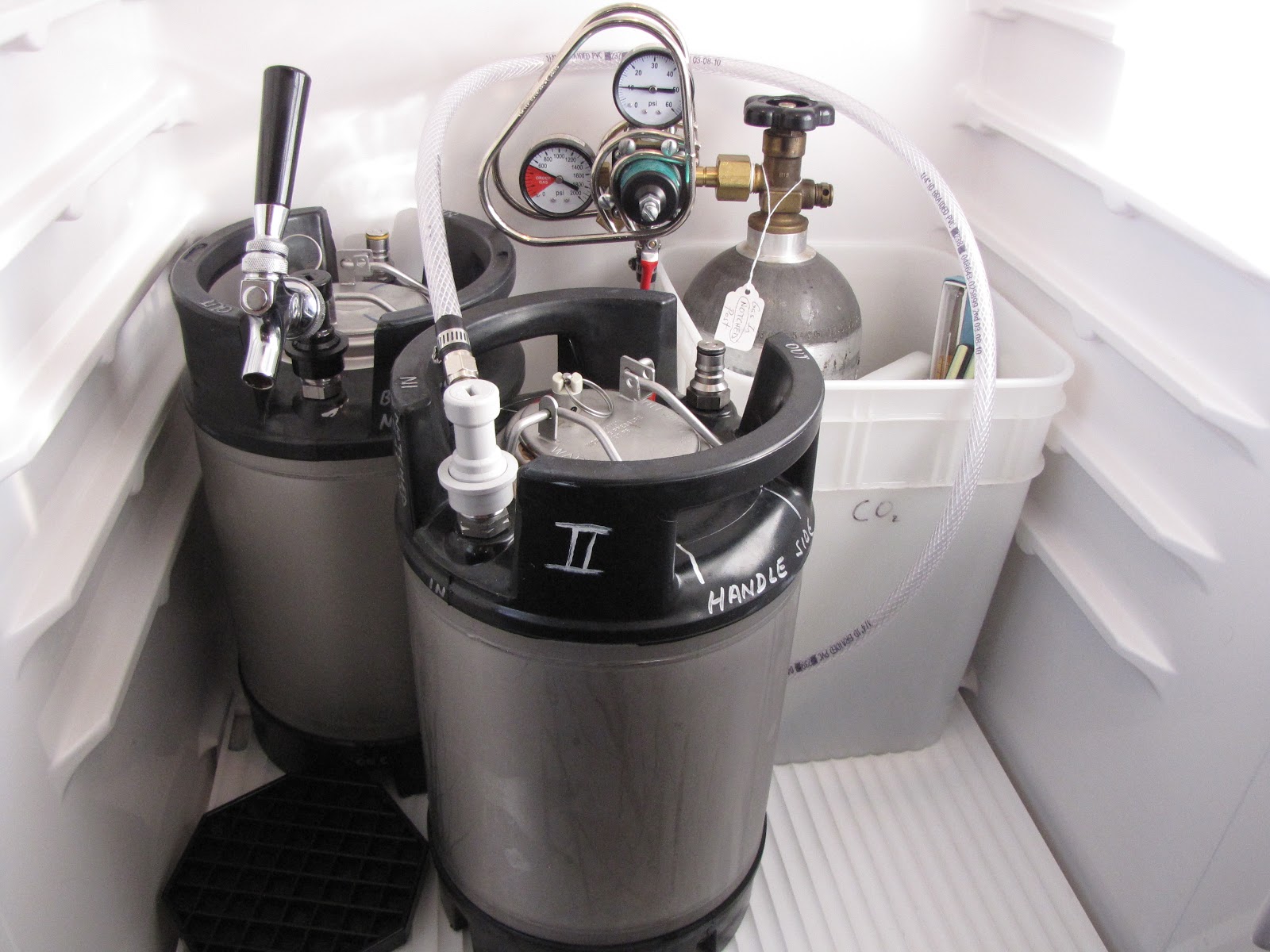
Happy Fridge


The Pennant Porter is ready for the New Year. Should be plenty of excellent quaffing in the offing!! Now I'll have to get to work on a World Series Stout. The 2012 San Francisco Giants are the World Champs. That's a better reason for partying than 1999 or the goddamn Mayan Calendar cluster-fuck, don't you think? I certainly do.

HAPPY NEW YEAR!

a.d. III Kal. Ian.

Sunday, December 9, 2012

Pennant Porter II

The beer fermented out quickly as I used two fresh packs of yeast. It never got below 1.020 and showed no more signs of fermentation so I decided to keg it up. I primed the two 2-1/2 gallon corny kegs with about 50 grams of dextrose each and filled them both with plenty left over. There was a lot of volume in this batch! I figure they'll need at least a week of conditioning, maybe more like ten days as the closet temperature hovers around 65 ºF. Then a week or two in the fridge and Pennant Porter should be ready by New Year's Eve.


a.d. V Id. Dec.


Sunday, December 2, 2012

Pennant Porter

After the deluge of the past few days the sun came out here at French Street Brewery in the State of Jefferson. It was a fine day to brew. Continuing the world champions theme for the 2012 San Francisco Giants is Pennant Porter. The Giants won the National League pennant in stirring fashion by defeating the defending champions on the 22nd of October, which also happened to be my beloved bride's birthday. A fine present, indeed. Today's brew was a simple extract--8 pounds of dark syrup and an ounce of Centennial hops. I used two packs of Safale-04 so the fermentation would be vigorous and complete. The OG reading on my refractometer was 1.048 (12 ºP) so it is a little bigger than the Championship Ale which was more of a light session beer. Looking forward to quaffing many pints over the holidays!


Sunday, October 14, 2012

Championship Ale, part II

The Giants emerged victorious from the League Division Series and now advance to the League Championship Series. The Ale emerged from its carboy slumber into a five-gallon keg, primed and ready. It's a light-colored session beer that I hope has a full hop flavor. I've made one or another version of Championship Ale since 1988, the year I started brewing. The Giants were the NL West champs in 1987. This one is will be ready by the time October baseball is over, and we can drink it to celebrate the exciting 2012 season. The NLCS will likely be very close--the Cardinals are, after all, last year's World Series winners. I expect the games to be close and the competition to be intense. And it starts tonight in San Francisco! Man, I'm thirsty already.


prid. Id. Oct.

Sunday, September 30, 2012

Championship Ale

In celebration of my favorite ballclub winning the NL West, I cooked up a batch after a long hiatus. It was a relaxed day as I kept it simple and used malt extract. You can make excellent beer with extracts, don't let anyone tell you otherwise. I haven't hopped on the homebrew hobby horse in a while, and it felt good to break out the kettle and fire up the stove. We had lovely weather in the State of Jefferson, and the Giants came from behind to beat the Padres. What could be bad?

I used six pounds of extract, two ounces of Centennial hops, a pound of 40ºL crystal, and Safale-05 yeast. I'm imagining myself drinking it now, thinking back on the wonderful 2012 baseball season. Way to go, Giants! Keep it rolling!


prid. Kal. Oct.

Sunday, August 19, 2012

Geeko Sapien

This is genius:


I hope I'm a Geeko Sapien.

Check out the "Infographics" section of the Beer & Whiskey Brothers blog.

(And thanks to Ryan for the link.)


a.d. XIII Kal. Sep.


Wednesday, April 11, 2012

Comin' Up!

The hops are sprouting. The Nugget came up first and it is now showing leaves. The Magnum was next, and the Cascade finally poked through the soil earlier in the week. The longest--the Magnum--is about 9 cm (that's 3-1/2 inches for you non-metricals). The shortest--the Cascade--is about 2 cm (less than an inch). It is very exciting as all three that were planted are now growing. It has been mostly cool and rainy but we did get a stretch of sunshine and the ground has warmed up. The MCN project is off to a good start.

a.d. III Id. Apr.